
#117 - The Evolution of Dennis the Menace: A Detailed Exploration of His Numerous Incarnations.
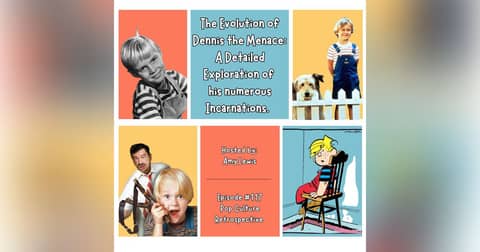
Send us Fan Mail Thank you for tuning in! On today's episode, we are discussing an infamous comic strip character who had a profound impact on my life, and that would be Dennis the Menace! Join me as we look back to his first appearance in newspapers in 1951, and all of the incarnations we've experienced over the last 75 years. In this episode, I mentioned my appearance on another fellow Pop Culture Podcast show, Retromade. You can find this awesome show here. I...






Thank you for tuning in! On today's episode, we are discussing an infamous comic strip character who had a profound impact on my life, and that would be Dennis the Menace! Join me as we look back to his first appearance in newspapers in 1951, and all of the incarnations we've experienced over the last 75 years.
In this episode, I mentioned my appearance on another fellow Pop Culture Podcast show, Retromade. You can find this awesome show here.
I was a guest a year or two ago, where we discussed the 1993 film, Dennis the Menace. You can find that episode here.
I also mentioned my friends over at the His and Hers Gen X Podcast a few times; you can find their fantastic show here.
Visit: https://www.popcultureretrospective.com/ for all things Pop Culture Retrospective!
Listen to the show, along with several other retro-inspired podcasts, and music from the '80s and '90s on the Q106.5 app (or website)!
Follow me on Instagram: https://www.instagram.com/popcultureretrospective/
Follow me on Twitter!: https://twitter.com/PopCultureRetro
Review the show! https://www.popcultureretrospective.com/reviews/new/
Pop Culture Retrospective Merch!: https://pop-culture-retrospective-pod.myspreadshop.com/all
Email me anytime: amy@popcultureretrospective.com
Episode #117
Play during intro: Classic TV Theme: Dennis the Menace
A few months ago, I was a guest on the " His and Hers Gen X Podcast,” where we discussed Calvin and Hobbes, the infamous comic strip, which reminded me of my love for yet another comic strip from my childhood. This comic strip achieved remarkable popularity, transforming into a series of books, multiple versions of a television show, both major and minor motion pictures, and an array of merchandise.
No matter when you grew up, I imagine you likely went through some sort of phase. Phase, in this case, meaning something you were really into, or maybe even became obsessed with. Perhaps you went through a dinosaur phase, a Barbie phase, a Ninja Turtle phase, or a Cabbage Patch phase. For me, I went through all of these phases with the exception of the Barbie phase. If you're a long-time listener of the show, then you probably know why. Anyhoo, each of the applicable phases for me lasted for a few months, maybe even a year or more; however, they pale in comparison with one that I am still subtly going through. And, without question, that would be Dennis the Menace. Yes, that Dennis the Menace. The blonde-haired, impulsive, but well-meaning little boy who started as a comic strip in the early 1950s. And if you are scratching your head and thinking, does there really exist a middle-aged woman who was obsessed with Dennis the Menace as a kid and remains endlessly fond of the character? The answer? Yes, that person exists. And that person is me. Now is your chance to learn more than you ever thought you wanted to learn or could learn about the one and only Dennis the Menace. This episode involved an extensive amount of research, almost to the point where it started to feel like this was more of a master’s thesis than a podcast episode, and I mean that in a good way. Get cozy because this episode is quite a doozy. As I approach my six-year podcast journey, this is the longest solo episode I have ever created. Through our look back on the comic strip, the live-action television show, and the other incarnations, you will learn heaps and heaps of information about this beloved character and why it really wasn’t Dennis who was the menace. So sit back, relax, and let's nerd out on nostalgia together.
This show is dedicated to the memory of my big sister Rebecca, a fan of all things pop-culture, particularly of the people, places, and things that defined the 80s, 90s, and early 2000s. Welcome aboard this pop culture time machine, I'm Amy Lewis.
This is episode #117: The Evolution of Dennis the Menace: A Detailed Exploration of His Numerous Incarnations.
Technically, the story of Dennis the Menace doesn't start in the 1950s, but rather in 1920 in Seattle, WA, where Hank Ketchum, the eventual creator of this notable character, was born. He was born to Dad Weaver, who was a WWI Navy Veteran who was very strict and often used a whip to beat Hank below the knees when he did something out of line. And his Mom, Virginia, was much gentler and sweeter; she was thankfully supportive of Ketchum's artistic aspirations. Hank had a younger sister. From an early age, Ketchum knew he wanted to be an artist. Part of this may have been tied to a friend of his parents who worked at an ad agency. Whenever he came over, he would draw sketches with what he called his “magic pencil.” Ketchum was entranced by his drawings; he even went so far as to trace them to better understand how to draw. After tracing the friend's drawings, he moved on to tracing the comic strips he found in the newspaper. Ketchum was hoping that maybe someday, he could work for Disney.
A teacher of Ketchum's noticed the young man's talent for animation. She would walk him to various classrooms in his school and would have him draw on the blackboard, showcasing his skill with cartoons. Kind of like Shel Silverstein, Ketchum was not very athletic or scholarly, but he could draw and use his sense of humor in his art. It was not only his teachers who noticed his skills, but also his neighbors, who would periodically commission him to do artwork. As he grew older, he took as many art classes as possible in school. He really wanted to be an artist for a profession, but his family was hoping he would be a repairman for a living, perhaps fixing Air Conditioners, which they felt was more reliable than cartooning.
In 1937, Kethum enrolled at the University of Washington, but dropped out after 1 year.
Eventually, Ketchum hitchhiked to Hollywood, where an Uncle of his lived. He let him stay at his residence for a time while his nephew took some of his first steps toward accomplishing his goals. One day, he walked into the Disney personnel office, sans appointment, and asked to meet with the employment director. Despite his persistence, he was told no. Thankfully, he later found work with a gentleman named Walter Lantz, who created a company cleverly called Walter Lantz Productions. Lantz is the mastermind of a notable animated character who was a royal pain in the butt, Woody Woodpecker Best Woody Woodpecker Laugh.
There, Ketchum worked as an in-betweener for the Andy Panda series. According to D23, which is the official fan club of all things Disney, an inbetweener is: an animation term for the artist who creates the drawings in between the extremes of an action drawn by the animator, assistant animator, and breakdown artist. He stayed there for about a year, learning many tools of the trade. Eventually, Ketchum did achieve his dream of working for Disney. He contributed his artistic talents to films such as Bambi, Fantasia, and many Donald Duck shorts.
In January of 1942, Ketchum was drafted into the military, and thankfully, he was able to continue building his skills as an artist. He created training materials for War bonds, and in his spare time, he submitted his cartoon drawings to the comic section of various newspapers and magazines. Eventually, many of the cartoons he created for the military would appear in the Saturday Evening Post.
In 1950, the idea for the character of Dennis the Menace came to fruition for Ketchum in an unexpected manner. At the time, Ketchum was married to his first wife, named Alice Louise Maher. One night while working in his office, Alice burst in to complain that their 4-year-old son, Dennis, had messed up his room instead of napping. She allegedly ran in and declared, “Our son, Dennis, is a menace!” A lightbulb went off in Ketchum's head, and thus, the creation of the infamous character began.
Ketchum's character of Dennis the Menace was forever 5 ½ years old. He had blonde hair with a distinct cowlick. Although he was dubbed a “menace,” Dennis was never intent on hurting anyone. He loves root beer, and he always hates having to take baths or eat carrots. Dennis Mitchell and his parents, Henry and Alice, would reside in Wichita, Kansas, at 2251 Pine Street, to be exact. Henry was an Aeronautical Engineer, and Alice was a stay-at-home parent. Ruff would be Dennis's furry friend, and Hot Dog (whom I don't remember ever reading about or seeing) was the family's rarely seen cat. Their next-door neighbors are George and Martha Wilson. Mr. Wilson is a retired mail carrier.
Dennis had several neighborhood friends who would appear in the newspaper comics and also in the subsequent television shows and movies.
Joey McDonald was Dennis’ best friend; he was younger than Dennis and appeared to be toddler-aged in both comics and on television.
Tommy Anderson was also considered a best friend of Dennis’; he periodically appeared in the live-action TV show and later cartoons. He was just as curious as Dennis, but better able to rein in his impulsivity. In addition, Margaret Wade, who appeared to be a little older than our protagonist, was basically a thorn in Dennis’ side. She seemed to have a crush on him, but Dennis, given that he is essentially the age of a Kindergartener, did not reciprocate despite her advances and many compliments. Gina Gillotti was another buddy of Dennis's. She was another character I admired because she was a tomboy, for lack of a better term, that isn’t so outdated, who wasn't afraid to run around with the boys and get full of mud, which I could relate to. There are a few additional characters who appeared in later versions of DTM, but we will discuss those a little later.
On March 12, 1951, Dennis the Menace debuted in the comic section of several newspapers, 16 to be exact. And a side note, during my research or should I say “Literature Review”, I realized that 1951 was an incredible year for American pop culture. For example, this year marked the debut of I Love Lucy, one of the greatest television comedies of all time, Pabst PBR aired the first beer commercial ever on TV, Catcher in the Rye, the classic novel by JD Salinger was released, and comedic genius Robin Williams was born. And let's not forget that 1951 is the year in which Tupperware came onto the scene. Food storage hasn't been the same since! And finally, one notable piece of slang at this time was ‘classy chassis,’ Old Car Horn - Sound Effect(HD) which was a term used to describe someone with a hot body. If you decide to use this as a pick-up line at a bar, please let me know. You can email me at: amy@pcr.com And, I also realized, after putting this episode together, that 2026 marks the 75th anniversary of Dennis the Menace. March of 2026, to be exact, marked 3/4s of a century of our favorite comic strip character.
By the end of the 1950s, the Dennis the Menace comic was syndicated in over 1000 newspapers. Further, the comic has appeared in 48 different countries and has been translated into 19 different languages. And although the end of the 1950s saw the rise in popularity of the comic, it also brought with it some tragedy as well. Ketchum’s first wife, whom we just discussed, died in 1959 when Dennis was just 12 years old, while he was away at a boarding school in California. She allegedly died from a drug overdose. She had struggled with both alcohol and barbiturate abuse. Hank and Alice were separated at the time, and Ketchum wasn’t exactly closely connected with his son. According to some reports, Dennis was not informed about his mother’s passing or visited by his Dad until his mother was buried.
Between the tragedy of his mother’s passing and the realization that Dennis had a learning disability, he was hoping his father would spend more time with him. Unfortunately, that never happened. The distance between the two of them would just get worse. And to add insult to injury, Ketchum remarried within several weeks of his estranged wife to a woman whom he met on a blind date. They abruptly moved to Switzerland, where Dennis would attend a boarding school. When that didn’t work out, Dennis was sent to attend another boarding school in Connecticut.
Ketchum and his son would have a strained relationship for the rest of their lives. Eventually, Dennis joined the Marines and fought in the Vietnam War, but sadly, like so many veterans, Dennis developed PTSD. He drifted in and out of jobs and, like his father, would marry multiple times. Ketchum said he never heard from his son very much, only when he allegedly needed money. Dennis expressed frustration with his dad for naming the infamous character after him. He wished his dad had chosen someone else as inspiration. After all, as far as I can tell, Dennis’ other real life siblings were never made into comic strip characters.
Despite the difficulties that would eventually unfold behind the scenes, the comic was so successful that various TV and movie adaptations were released in the decades that followed. The first, and probably most iconic, incarnation of the comic was the live-action DTM television show that aired from 1959 to 1963. In 1958, Columbia Pictures started a nationwide search for the perfect young male actor to play the coveted role of Dennis, but let’s back up a few years to learn more about the eventual star of the show.
Born in Hollywood in 1951 to parents Jay and Dorothy North, their son, also named Jay, was hoping to be selected for the role. Jay and Dorothy had a tumultuous relationship. Their marriage was described as unstable, and North’s father was allegedly an alcoholic. When Jay was just 4 years old, his parents separated, and his dad abandoned the family, never to be seen again.
Thankfully, Dorothy was able to work and support herself and her son through her work as a secretary in the television industry. Through some connections from her job, she was able to help her son get small parts on local television shows. When they heard about casting for Dennis the Menace, Dorothy worked her magic to secure an opportunity for North to audition. When Jay North gave it a shot the first time, it did not go very well. Somehow, North's agent convinced the casting department to let the boy have another chance. They relented, and miraculously, North got the part.
Despite being a redhead, North would play the role of Dennis Mitchell, and he would have to dye his hair. Even though the show was filmed and broadcast in black and white, his natural hair color was simply not up to snuff.
Dennis the Menace premiered on October 4, 1959. Classic TV Theme: Dennis the Menace
North's mother had to continue working at her job, so his maternal Aunt and Uncle were in charge of his well-being and would serve as his on-set guardians. North thus began his exhausting schedule of promoting the show, filming the show, and attending school on-set. Further, as the show became more popular and the name DTM became a household name, North appeared in many commercials. He appeared in character in commercials for products like Skippy Peanut Butter, cereal brands, mayonnaise, and chocolate milk. Even Dennis’s on-screen parents, Henry & Alice, appeared in a commercial for Rice Krispies.
As previously mentioned, Dennis was played by Jay North. Herbert Anderson played the role of Henry Mitchell. He was born in 1917 and would go on to have a successful acting career, first starting with Warner Bros. In addition to DTM, he also appeared on TV shows here and there, like The Brady Bunch, Happy Days, and earlier television sitcoms. He enjoyed a lengthy career until he had to retire in 1982 due to heart surgery. He passed away in 1994. The role of Alice Mitchell was played by Gloria Henry (what a coincidence that her last name was the same as her on-screen husband’s first name!), was born in 1923 and lived until 2021, which was incredible. Gloria Henry was actually her stage name, but I believe that came long before the comic strip or the TV show. She served as a mentor to Jay North and was a busy actress for many decades. She appeared on shows like Perry Mason and dozens of so-called “B” movies. Joseph Kurns played the role of crotchety old Mr. Wilson, and he did a brilliant job doing so. Kurns was born in 1907 and had a pretty fascinating life leading up to his role as Mr. George Wilson. He allegedly was able to cover his college tuition by teaching a course about theatrical makeup. He also had experience in radio and was a pipe organist. Sadly, he passed away in 1962 due to a brain hemorrhage. This happened while the television series was still on the air. Sylvia Field played the lovable character of Mrs. Martha Wilson. She was born in 1901 (same year as WD) and appeared on tons of TV shows throughout her career, including but not limited to: Lassie, Petticoat Junction, and The Thin Man.
She, too, appeared to have continued a close friendship with Jay North following the eventual end of the series. She passed away in 1998. When Joseph Kurns passed away unexpectedly during season 3 of the show, a new character named John Wilson, played by Gale Gordon, appeared as George’s brother to finish out the season. And apparently, they couldn’t figure out how to keep the character of Martha Wilson in future episode plots, so she was given the boot. Instead, actress Sara Seegar joined the cast to play Eloise Wilson, who was married to George. And while Gordan and Seegar both had impressive acting resumes, they never really “fit” in the show, if I were to share my opinion. In order to make this episode run a tolerable length of time, I will just give background information on the main characters of the many incarnations of DTM.
Here are a few episode examples from the DTM Live Action Series. This information was pulled directly from the invaluable website IMDB:
S1 E1 “Dennis goes to the movies.” Dennis sneaks out on his sitter to go to the movies where his parents are, and causes trouble at the theater.
S2 E5: “The Stock Certificate.” Trying to be helpful, Dennis throws Mr. Wilson's old telephone book into the recycling truck. Mr. Wilson had stashed a $500 stock certificate in that phone book. Wilson and Henry Mitchell go on a hectic search for the discarded phone book.
S4.E8 ∙ “San Diego Safari” - Dennis, along with his parents and the Wilsons, visits the San Diego Zoo to bring back a chimpanzee for their town zoo. However, the chimp causes a ruckus at the motel where they are staying overnight.
One may think that being a young person on a successful TV show would be a lot of fun, but sadly, it was quite the opposite. Appearing in Dennis the Menace was not only isolating but also incredibly damaging to Jay North. North really only socialized with his co-stars in between filming scenes. He ate lunch by himself in his dressing room. His schedule was overwhelming, and the adults who were supposed to be looking out for him had unrealistic expectations of the young man.
And likewise, with the show becoming more popular, his Aunt and Uncle became more and more strict, especially his Aunt. North was allegedly abused, both physically and mentally, by the hands of his aunt.
If, for example, he messed up his lines, she would apparently assault him behind the set. His performance had to meet her standards; otherwise, he would be the target of her aggression.
For many years following the ending of the show, North could not stomach watching reruns, as it was just too triggering. He kept all of this trauma to himself. He was afraid that he would make his Aunt even angrier than she already was. Apparently, the only ‘menacing’ that happened regarding this infamous comic character was behind the scenes at the hands of a relative who was supposed to be helping him.
In 1963, much to North’s relief, the show was cancelled. Throughout the 1970s, North played various roles here and there, but he would eventually leave Hollywood behind. He had been typecast as DTM, and it was hard to find work, so he decided to move on. Instead, he had a notable career in the military and later as a correctional officer, working with troubled youth who needed some guidance. Thankfully, unlike other child stars, North’s Mom did not spend all of his celebrity compensation. Instead, she invested most of his earnings so he was never in crippling debt, even after he left the limelight. North earned the equivalent of roughly $5,500/episode while playing Dennis, so over the course of the 4 years of the show, his earnings were nothing to sneeze at. Sneeze Sound effect (Male) Are you serious right now? Get a flippin' tissue, will ya! Like his father, North would marry several times and was also a stepparent.
Dennis the Menace would live on both during and after the show’s run through successful merchandising of the energetic cartoon character. Dennis could be found on practically anything from chapter books to metal lunch boxes, coffee mugs, holiday ornaments, colorforms, plates, and so much more. More you say? Sure thing. There were DTM books on tape, record players with his likeness on them, paperback books, comic books, view master slides, compilation books, figurines, bobbleheads, dolls, toolsets, puppets, and that’s just the tip of the iceberg. If you listened to my recent guest appearance on the His & Hers Gen X podcast, you might recall our discussion about another iconic comic strip, Calvin & Hobbes. One interesting point that emerged during our conversation was how differently the author and illustrator Bill Watterson approached merchandising for his beloved comic. While he shied away from media attention and avoided merchandising, Hank Ketchum, the creator of Dennis the Menace, took the exact opposite approach, aka he merchandised the crap out of it. It’s a technical term. Also, if you enjoyed visiting your local Dairy Queen between roughly 1971 and 2001, DTM was the brand's official mascot.
Every single time I went to the local DQ in my hometown, usually after a baseball game, my vanilla soft serve, covered with butterscotch syrup, tasted that much better in a Dennis the Menace cup. Seeing my favorite character on these cups always mattered more to me than whatever frozen treat awaited me and my sensitive teeth.
During the 1970s, Dennis the Menace continued to appear in newspapers across the country. Like many comics of that era, the animated characters typically portrayed individuals of Caucasian descent. Ketchum, following in the footsteps of Charles Schulz, attempted to introduce a character of African descent into the comic. Unfortunately, his effort to use a play on words to spoof and highlight discrimination backfired. As a result, the character, Jackson, disappeared almost as quickly as he had been introduced. The character's appearance sparked significant controversy among readers, who felt offended for various reasons. Although it appeared that Ketchum aimed to address the challenges faced by African Americans by spoofing many of the offensive stereotypes utilized in print and on the big screen, his execution fell short.
Despite the brief uproar in the 1970s, and early 1980s, the comic strip remained incredibly popular, yet Dennis did not return to television until the mid-1980s, this time as an animated cartoon. This series is likely what started my decades-long obsession with this infamous character. Sponsored by General Mills and produced by Dic, the series first aired in syndication, and the second season aired on CBS during its Saturday morning cartoon lineup. Between the many, many years of reruns as well as straight-to-home-video compilations, Dennis the Menace became a household name within my family during this timeframe, whether my parents or sister liked it or not. Taking bits of inspiration from the original comic strip and the live-action TV series, the animated series was a bit more imaginative than the other incarnations. Dennis got into more elaborate and potentially dangerous trouble on this show than he did previously. Gone were the days of painting a fence when he shouldn’t have, or accidentally overfilling the bathtub and using it for a swimming pool. Instead, his misadventures were replaced with unlikely scenarios such as breaking into an old gold mine or being chased by ghosts in a haunted house. Here are a few episode examples to highlight what I mean, all taken from IMDB:
S1.E3 ∙ Cheer Up/Ghostblusters/The Life You Save
Mr. Wilson slips on Dennis' skateboard and has to go to the hospital. Once there, Dennis arrives to cheer Wilson up... Wilson is in for the time of his life! The kids discover an abandoned old gothic house that Dennis decides would make a great club-house. The kids begin cleaning the place up until a pair of ghosts appear!
The others want to leave the place, but Dennis who never once sees the ghosts chides them for being scaredy cats, and gets them to stay. Finally the "ghosts" are revealed as a couple of crooks who are using the old house to hide their ill-gotten gold, and using "scare tactics" to frighten the kids away. Dennis saves Margaret's life, and she won't let him forget it. Desperate to get Margaret out of his hair, he tries to arrange to have the girl save his life. All his efforts are futile...until an escaped grizzly bear happens on the scene.
S1.E10 ∙ Dennis' Yard Sale/The Abominable Snow Menace/It Came from the Planet Dennis (note the first episode’s description didn’t age well):
When Henry and Alice leave to go to a "Poor People's" charity auction, Dennis decides to help the poor people by selling most everything in the Mitchell household. Mr. Wilson, who is supposed to check on Dennis but arrives late, is shocked when he sees what Dennis is doing. So, he and Dennis go on a madcap scavenger hunt throughout the neighborhood to retrieve the pieces Dennis has sold before Henry and Alice get back home. By the time they get back with all of the pieces, Henry and Alice arrive with lots of "new" junk. So much so that Henry declares that maybe they should hold their own auction! Wilson falls down in exhaustion. Vacationing at a ski lodge, Dennis and Joey cause so much chaos that the manager dresses as a snow beast to scare them off. But when the beast gets into trouble Dennis rescues him and the guests vote for the boys to stay. Dennis and PeeBee, in an effort to help Dennis clean his room, decide to build a robot to do it for them. Once built, the robot escapes and causes havoc throughout the neighborhood. Mr. Wilson, who is being bothered to cut the lawn by Mrs. Wilson, thinks it's a creature from outer space and gets caught up in the chase. In the end, Wilson finds out that it's Dennis' creation and gets the bright idea of using the robot to cut his lawn!
S1.E17 ∙ A Better Mousetrap/The Wizzer of Odd/Canine Car Wash
Mrs. Wilson will not return until Mr. Wilson gets rid of all the mice.
PeeBee's special mousetraps are regarded as circus rides by the mice and they come from everywhere to play, which costs Mr. Wilson a lot of quarters, the price he pays to the boys for each mouse captured. A take-off on the "Wizard Of Oz", in which Dennis and Ruff are carried off to Munchie-Land by a cyclone... there they meet Joey, PeeBee, and Gina, each looking for Courage, a Brain, and a Heart, respectively. Before reaching the City of Odd, they escape the clutches of Margaret, the wicked Witch.
Finally they find the Wizzer, who looks a lot like Mr. Wilson, and Dennis wakes up, back in his own bedroom. Dennis and Joey go into the dog washing business and follow Mr. Wilson to the car wash. Halfway through the cycle Dennis opens the car door and a parade of wet animals soak Mr. Wilson's car followed by the jet spray of the rinse cycle.
The typical cast of characters appeared in this animated adaptation of the comic strip. However, several notable voice actors and actresses lent their talents to the show.
Brennan Thicke, son of Alan Thicke and brother to Robin Thicke, provided the voice of Dennis. The late and incredibly talented Phil Hartman voiced Mr. Wilson and Henry Mitchell. Marilyn Lightstone provided the voice of not only Alice Mitchell, but also Margaret. This came up in an old episode of the podcast, but Marilyn Lightstone has done a TON of voice acting work and traditional acting work, including her role as Miss Stacy in the Anne of Green Gables television series from the 1980s. Stevie Louise Vallance also contributed her voice talents to play Alice Mitchell. We discussed her briefly on the WTF children’s shows of the 1980s a while back. She played the character of Whazzat Kangaroo. Jeannie Elias provided the voices for Margaret Wade, Joey McDonald, and Tommy.
Making his first appearance that I can recollect, the character of Pee Bee Kappa debuted when this animated series did. He is the stereotypical nerd character so often seen on television and in movies in the 1980s. He is very smart, has his own chemistry lab in his home’s basement, uses vocabulary that Dennis and his friends often don’t understand, etc., etc. Pee Bee also appeared in the 1987 film and the 1993 animated series. There was also an African American character named Jay Weldon, who was one of Dennis’s friends. I don’t recall him appearing in a ton of episodes; however, I do remember one in which he is playing basketball, queue the stereotyping, and my daily forehead slap as well as my inner Nell Carter GIMMIE A BREAK.
A while back, there was a meme which circulated social media to Gen Xers and elder millennials, and it said something along the lines of: “at one time, we all had one tape recorded VHS tape with an obscure movie on it that we all watched,” and for me, it was, without question, the 1987 made for TV movie, Dennis the Menace (Dinosaur Hunter). The movie was directed by Doug Rogers.
This movie, as you may have predicted, was all that was good and bad about made-for-TV movies. The acting wasn’t great, the storyline was somewhat unrealistic, but I loved every minute of it. The gist of the movie, spoiler alert, is what follows. Dennis remembers that his Dad wanted trenches dug in the family’s front lawn so they could have a sprinkler system installed. While destroying their front yard, Dennis, along with his neighborhood friends, discovers a real dinosaur bone, buried underground. Dennis convinces his parents that they should call Henry Mitchell’s old friend, Bones, from college, who could take a look at it and determine whether or not it is authentic. Chaos and drama ensue, and before we know it, Bones, unable to find other dinosaur bones in the Mitchell’s yard, decides he wants to create a media frenzy, so he plants several bones in their next-door neighbor’s yard. Bone’s dishonest tactics are discovered, and he is sent packing. While the dinosaur bone that Dennis discovered is in fact real, there is no evidence of any more fossils buried in their yard. Bones and Mr. Mitchell's boss's plan for a dinosaur-themed family park became extinct before it could even be built.
The main character of Dennis Mitchell was played by Victor DiMattia. Born in 1980, DiMattia was a pretty successful actor at an early age. He starred on TV shows like Family Ties, Growing Pains, and Designing Women. He also played the role of Timmy Timmons in The Sandlot and played a character named Tommy in Cool as Ice. Cool as Ice: "Drop that Zero" (HD) According to his IMDb profile, his younger brother is Brian Bonsall. Like many young child actors of the 70s and 80s, Bonsall was added to a sitcom as a new family member when the show's popularity began to wane. In his case, he joined the cast of "Family Ties" during a time when the series was struggling to maintain engaging plotlines. To my knowledge, these characters never actually “saved” a show, and I’m looking at you, Cousin Oliver from the Brady Bunch! I found out through my research that there is a sitcom troupe referred to as the “Cousin Oliver Syndrome,” wherein a (new) young child actor is added to a flailing TV show to attempt to win back viewership via an adorable child. Cousin Oliver Is Convinced He's Bad Luck
Jim Janson played the character of Henry Mitchell. Born in 1945, Janson has had a successful career as both an actor and director. I believe that Janson resembled the original cartoon character of Henry Mitchell the most, followed by Herbert Anderson from the live-action series. Anyhoo, Jim Janson has appeared on notable television shows, including Parks and Recreation, Law and Order, and a relatively short-lived sitcom with one of the catchiest theme songs of all time, Just the Ten of Us. Classic TV Theme: Just the Ten of Us This song still slaps so hard. So freaking catchy! It’s one of those, you know, randomly stuck in my head for no reason television theme songs that appear several times each year. Let's get back to the cast of characters, though, with the help of some transition music.
Patricia Estrin played the role of Alice Mitchell. Born in 1949, Estrin is an accomplished actress and producer. She has made guest appearances on many successful television shows, such as Newhart, Cagney and Lacey, and a show I completely forgot about until this very moment, The Father Dowling Mysteries. Father Dowling Mysteries Intro (Season 1) After listening to the theme song for the first time in 3 decades, I instantly recognized it. However, I know I heard that song dozens and dozens of times when the show was still on the air, yet I do not recall ever watching the show. Anyways,
Mr. Wilson was played by William Windom, who was born in 1923. He had many TV, theatre, and stage credits to his name, including stints on Broadway and guest spots on TV shows like All in the Family and Highway to Heaven. His film debut was in “To Kill a Mockingbird,” not too shabby. He passed away at the age of 88 due to congestive heart failure.
Patsy Garrett played the role of the beloved character Martha Wilson. Born in 1921, Garrett had a fascinating career in the entertainment industry, providing her voice for several different Hanna-Barbera cartoon characters. She was also on Maude, Sanford (which I'm pretty sure was a spin-off of Sanford & Son). She also starred in the film Benji, which my sister and I rented a ton of as kids. Garrett lived a long and busy life, passing away in 2015.
Fun fact about the movie: in one scene, Margaret shows Dennis a baby doll that she recently got and tells him that she named the doll after him.
Allegedly, and somehow I never picked up on this, even though I saw the movie hundreds of times, it was actually a “My Buddy” doll My Buddy and Kid Sister commercial (1985) HD Quality dressed up in different clothing. And I recently re-watched the movie and I can verify that Margaret was, in fact, holding a My Buddy Doll sans hat and overalls, which has been replaced with a black suit.
We will now move on to the incarnation that I have dreaded talking about, the one I have nightmares about, the only one that I firmly believe takes out a fancy white glove and slaps the original DMT comic strip character directly across the face. But I digress. The origin of the horrific avalanche that ultimately engulfed the spirit of Dennis the Menace can be traced back to 1993, when the initial 'snowball' began its roll with the release of a full feature film by the same name. https://www.youtube.com/watch?v=8CogDP0vlfw
To keep things consistent, here is a description of the movie taken from IMDB: When his parents must go out of town on business, Dennis stays with Mr. and Mrs. Wilson. He is driving Mr. Wilson crazy, but he is just trying to be helpful, even to the thief who has arrived in town.
I am not even sure where to begin the discussion around this early ‘90s adaptation of one of the most popular comic strips of all time. I will start with a few positive notes, though. First and perhaps most important, the casting for this film was sheer perfection. Mason Gamble, who was new to the world of acting, did a decent job as a young child portraying a beloved character. He is likeable and showcases emotions with a lot of maturity. Second, we have the cherished next-door neighbors played by the acting brilliance of both Walter Matthau and Joan Plowright. Matthau wasn’t necessarily someone I would immediately think of when presented with a question about who would be a good actor to portray Mr. Wilson, but in his own superb manner, he took on the character and knocked it out of the park. Joan Plowright, arguably one of the most talented and decorated actresses of her generation, did a fantastic job portraying the calm and nurturing energy of Mrs. Wilson, which so many fans have come to love. And when she reads a poem to Dennis one night when he was having trouble falling asleep makes me want to cry one single tear of endearment while I lie in the fetal position. And this concludes my positive thoughts about the film.
When I heard there was a Dennis the Menace movie coming to theatres when I was at the ripe old age of 10, I was ecstatic beyond belief. I couldn’t believe it!
This period of my life was when going to the movies was not only reasonably priced, but it was a favorite pastime of my family and my friends. So the fact that one of my all-time favorite characters, who I had admired for so long, who I read about in comic strips and whose 1987 made-for-tv-movie I had memorized all of the lines to, was getting a full feature length film, made me feel like I had died and gone to heaven. I am not kidding.
Being that I was 10, however, my opinion on the film at the time was both naive and positive. My dad bought me the movie poster to hang in my room at his house. I owned a copy of the movie on VHS, the list goes on and on. I hadn’t seen the movie for probably 25 years up until recently when I re-watched it in preparation for a guest spot I did on the podcast Retromade. The host, Katie, had a series focused on John Hughes ’ filmography and I was lucky enough to be asked to a guest to discuss the 1993 film, without the host knowing, even just a little bit, how big of a Dennis the Menace fan I was. Side note - if you love this podcast, you will love Retromade. I will leave a link for the podcast and the DTM episode I was on in the show notes.
In my opinion (which is not the end-all be-all) I think this movie was way too far removed from the ethos of the Dennis the Menace character; in fact, I feel like it actually insulted said ethos. I’m not kidding. I am not a film critic or a movie expert. However, I will say, if there were a Dennis the Menace fan club, I would be a proud card-carrying member. The antics displayed in the movie aligned too much with Home Alone and the overdone accidents and pranks. The character of DTM was never one to intentionally cause any harm or to do something extremely dangerous. Like the "DTM" character, my children, for example, often jump into action when they overhear talk of something broken or missing. Similar to Dennis, they attempt to solve the problem without being asked or offering to help by getting permission first. However, their well-intentioned efforts usually lead to a bigger mess or a whole new set of complications. For example, our internet didn’t work properly one evening so I told my wife about it and how I would try to reset the router soon. My youngest son, who, side note, could easily play the character of DTM because he is extremely animated and looks just like him, decided to take the matter into his own hands when we were occupied in a different room. He unplugged and re-plugged in all of the electronic devices on the same shelving unit where the router is, and I then had to spend the next hour trying to get everything working again. I highly doubt my son’s goal was to upset me, but he tried to help, and it didn’t pan out, yet I know his heart was in the right place.
Most of the antics or accidents that Dennis has in this movie are unrealistic, inept, and humorless. As an example, in an early scene, Dennis tries to visit Mr. Wilson at his house, where he is sleeping in his bed. Dennis assumes that he is sleeping because he doesn’t feel well, so he decides to take it upon himself to administer over-the-counter pain meds to Mr. Wilson via slingshotting an aspirin into his mouth, which he promptly begins to choke on.
This gag seems written by someone who is very out of touch with what children may actually do in a situation like this; it just doesn’t make sense.
And then, of course, shortly after the choking scenario, there has to be an obligatory injury of sorts to Mr. Wilson’s groin area. Watching Walter Mattheu’s face superimposed onto a stunt double's body, slip and fall into the infamous gymnastic floor routine splits position made me feel confused and uncomfortable, and that’s about it. I thought this was a movie, not America’s Funniest Home Videos, where half of the submissions are a little kid hitting their dad, always in a sensitive area, with a baseball after swinging their Little Tikes bat. Scenes like these really reminded me why this movie is a poor adaptation of the beloved comic strip. If it were called Tommy and his next-door neighbors, I wouldn’t have batted an eye, and I probably wouldn’t have seen the movie anyway. Other actors who were a part of this film include Robert Stanton, who played an unconvincing Henry Mitchell (not that he is a bad actor, just not right for this part), and Lea Thompson, who is a well-known actress starring in a ton of memorable and very quotable movies; this is not one of them.
The real nail in the coffin for this movie is the disgruntled hobo who somehow lands in the same town as the Mitchell family and causes a lot of stress, anxiety, and fear amongst the community. In all of my years of reading the comic strips, watching the cartoon series, etc. etc. I do not recall the presence of a greasy, scary, purse-snatching hobo and for some reason, this character ended up in the film and did nothing to add to the movie, it only took away from. As the story goes, the hobo, played quite brilliantly by Christopher Lloyd, was a kind gesture of sorts, I guess you could say, by John Hughes. Apparently, Christopher Lloyd was offered the role of Harry in Home Alone, which he turned down. When Home Alone became such a monstrous success, Lloyd regretted turning down that coveted role. As a result, Lloyd offered Hughes his incredible acting skills with a specific ability to portray a dishonest man who scares children, if the opportunity ever arose.
I am not sure how this all came to fruition as John Hughes CO WROTE this movie with Hank Ketchum my inner Nell Carter kept saying gimmie a break! however, it was determined that what this movie really needed was a bindlestiff (it’s a real word, you can look it up!) with yellow, rotting teeth, a wardrobe that looks like it once belonged to Dr. Teeth from Electric Mayhem before it was run over 1000s of times on the freeway and dunked in a vath of motoroil and dried in the hot summer sun. Oh, and said bindlestiff would be named after a common street weapon. SS has a family-friendly character written all over it.
Somehow, a decent portion of the film is designated for his character’s subplot, which includes stealing purses from playgrounds, demanding fruit from small children with the help of his switchblade, and being forcibly dropped onto a floating steamer trunk in a filthy river with a belly full of pork n’ beans after he essentially kidnaps Dennis. Don’t get me wrong, I love Christopher Lloyd, and his ability to play a convincing role as a drifter is truly outstanding and is still ominous to this day. However, this sinister character doesn’t fit within the confines of what a DTM movie should have looked like. My sister and I used to re-enact a SS scene with each other all of the time. I would pretend to be a creepy hobo and I would say to her: “What you got there, sport?” and she would then grab a piece of fruit, cross her eyes, and reply “A apple.” In the movie, this exchange does happen verbatim between SS and a little boy named Gunther who is, unfortunately cross eyed (oh and a foot short for his age according to Mr. Wilson).The only part we couldn’t reenatct was when SS buts out his weapon of the same name, stabs the apple, and proceeds to peel and eat it while a stunned Gunther looks on in terror. And what further added to his petrifying presence was the foreboding music that played whenever he appeared in a scene. Jerry Goldsmith Tied Up
The movie concludes with Dennis’ parents returning home from their trip, learning about their son’s disappearance, aiding in the search, and rejoicing the minute he arrives home on his bicycle with a wagon in tow. And now that I say that, I believe SS is tied up on said wagon. I think the title of this movie should have been called “The Story of Dr. Teeth’s Evil Hobo Twin Kidnaps a Little Boy While He Was Being Watched by his neighbors, with a fairy tale ending.”
A reporter from Entertainment Weekly put it best when she said this about the film:
If you loved Dennis the Menace as a kid, do yourself a favor: Skip this film and hold on to your memories.” I couldn’t agree more. Before we move on to the additional incarnations, here are a few behind-the-scenes trivia tidbits you may not have been aware of:
After filming the scene where SS approaches a little boy named Gunther, who is enjoying a snack in his backyard, the child actor, Hank Johnston, became so frightened of Christopher Lloyd's character that he was never comfortable approaching him again on set. Walter Mattheua was reportedly referred to as Mr. Wilson for the rest of his life following the release of the movie. 20,000 little boys auditioned for the coveted role of Dennis the Menace.
A vast majority of this movie was filmed in Hinsdale, IL which isn’t very far from where I grew up. As a matter of fact, I frequently biked from my house to Hinsdale and the surrounding areas. It is a beautiful community. And finally, Hank Ketchum was still actively drawing and writing DTM comic strips when this movie was filmed and subsequently released.
Following the success of the movie, another cartoon series debuted on Saturday mornings, but this time it was called “All New Dennis the Menace.” All-New Dennis the Menace (1994 CBS series) Opening Theme In the interest of time and limited information available, we will touch on this briefly. I do remember when this show aired, and I made a point of watching it every Saturday morning on CBS. I couldn’t believe DTM got a second cartoon series a few years after the original one debuted! The animation was relatively similar to the original series, but by that point, the quality of animation in general had made major improvements. Further, many voice actors and actresses returned from the mid 80s series to contribute to this version. According to my extensive literature review, it appears as though HK did not contribute his writing talents to this cartoon series. And finally, from what I can tell, the show only aired for 1 year, and I don’t recall it ever airing in syndication, or if it did, it didn’t last very long.
Merchandising the infamous character was in full-swing following the release of the feature film. At one time, you could purchase DTM-themed items such as a super nintendo game, a Tiger Electronics handheld game, a colorful watch, buttons, and a host of other memorabilia.
And, if you look up merchandise or memorabilia which has been created more recently on sites like Etsy, you will find stickers and candles with Gunther on them, saying “A apple” or a t-shirt that says Forts Don't Got Carpet like Joey says during one scene in the movie. There is yet another Gunther sticker available where you see his head, eyes crossed, with the word Yep on it, referring to yet another scene from the movie. In said scene, Dennis, Gunther, and dozens of other neighborhood kids are all playing hide and seek. Dennis instructs Gunter to keep his eyes on Mr. Wilson, but he gets distracted. Dennis says to Gunther: Are you watching where everyone goes? And a cross-eyed Gunther says, “Yep.” So, despite the movie being the biggest flop of 1993 in my book, it is definitely a quotable movie. I will give it that.
Several sequels would follow in the late 1990s and I have not had the stamina, nor the patience to watch any of these films.
If the original live action movie is abysmal, how tolerable will the sequels be? Have you ever watched, or attempted to watch, at least one of the 4 Home Alone movies beyond the first two? Spoiler alert, they play about as well as counterfeit earbuds, which is horrendous at best. We attempted to watch one of the sequels, which I tried to find the humor in, but it was so painfully terrible that I had to leave the room and read a book for fear of losing brain cells. I just couldn’t take it. That being said, here is some brief info about these asinine sequels, both of which I am quite positive Hank Ketchum co-wrote with a small group of screenplay script composers.
1997: A Dennis the Menace Christmas. IMDB description: To make sure that his beloved neighbor Mr Wilson has the perfect Christmas, lively 6-year-old Dennis Mitchell makes a long list of things needed to make it work. But is Mr. Wilson willing to change?
1998: Dennis the Menace Strikes Again. IMDB description: After a failed attempt to find the perfect birthday present for Mr Wilson, the mischievous little terror, Dennis, tries to save him from a pair of swindlers and their bogus youth remedies. Will he manage to keep their friendship strong? Trailer: Dennis the Menace Strikes Again - Trailer
Justin Cooper played Dennis.
Cooper was a child actor whom you would remember if you saw him, maybe not his name, but you’d recognize his face as he appeared periodically on TV on shows like ER and Boy Meets World. Also, and I swear I am not making this up, Don Rickles played Mr. Wilson and Betty White played Mrs. Wilson. How did they manage to attract such talent? Carrot Top also had a role in this movie. Dwier Brown played Henry Mitchell. Heidi Swedberg played Alice Mitchell. Fun fact about this movie, DTMSA was the last, live-action film that Don Rickles starred in before he died. Apparently, Rickles decided that DTMSA was the hill he wanted to die on and I can’t say that it was worth it. I kid, I kid. Don Rickles was a once-in-a-lifetime comedic talent, as was Betty White who my sister and I adore, and I cannot believe they were convinced to be a part of this film. I am so sick and tired of senior citizens being taken advantage of. First, they are manipulated into depleting their life’s savings and then they are convinced to star in a sequel to a sequel one of the worst movies from the 1990s? It’s disgraceful and all of those involved should be ashamed of themselves.
As I worked on this episode, one question kept coming to mind: Among all the post-live action television series, cartoons, movies, and other adaptations, which do I, Amy Lewis, an expert on all things DTM, believe most accurately depicts the ethos of DTM? The answer? The 1987 made for TV movie. And here is why. First of all, the TV movie was appropriate for children of all ages, there was no scary villain other than Bones who was more of a schmuck looking to make a quick buck, however he was not intimidating. Further, the character of Dennis the Menace was portrayed fairly accurately in regard to his age and developmental stage. Also, Dennis was certainly prone to causing frustration at times to the adults around him, but usually it was by accident and he started off with good intentions. Nothing he did was extreme, shocking, inappropriate, or slap stick. And finally, the Mitchells and the Wilsons were portrayed very closely to the comic strip. Alice and Henry were not afraid to re-direct their son and just like in the comic, he was periodically put in the corner to think about what he had done. George and Martha Wilson were not afraid of what Dennis would do, nor would they run inside and lock the door when they heard him coming. Mr. Wilson would often get annoyed with Dennis but he didn’t dislike him and Mrs. Wilson treated him like her surrogate Grandson. And guess what? This version of DTM is the one I watched the most, hands down. Even young Amy knew which portrayal of Dennis was the most accurate.
Transition to episode conclusion
Hank Ketchum retired from producing the DTM comic strip in 1996. Before his passing from cancer in 2001, Hank Ketchum was made the honorary mayor of Wichita, KS, where the DTM comic was set. Distribution, licensing, and other facets of the DTM empire still happen through various syndicates and private companies. I hope that, at some point in the future, Dennis the Menace makes an appearance in one way or another so that future generations can enjoy this comic strip character as much as I did and still do.
In April of last year, at the age of 73, Jay North passed away from cancer.
A close friend of his named Laurie Jacobson described North as having a heart "as big as a mountain" and said he "loved his friends deeply." to NBC news.
"He called us frequently and ended every conversation with ‘I love you with all my heart,’” she said on Facebook. End quote.
I hope you enjoyed my dissertation on Dennis the Menace as I work toward earning my doctorate in Niche Pop Culture. Okay, that’s not true, but to say I am a DTM nerd would truly be an understatement. Thank you for taking the time to listen to this detailed story about the history of this beloved character. My sister was always so supportive of my love for Dennis the Menace. She knew it wasn’t a phase, but it was someone whom I could relate to on many levels, especially during a time when there weren’t many female-led Saturday morning cartoon characters, or comic strips with a rambunctious young girl who, for example, loved to skateboard, had a vivid imagination, and rode BMX bikes like I did.
If you want to learn more about this podcast, check out merch, visit my blog, send me a message, and so much more, visit popcultureretrospective.com. Also, don’t forget to check out Q106.5 app, available for both iPhone and Android users. You can listen to 80s and 90s music all day long as well as check out other fellow retro-inspired podcasts. Here is a bit more info on this super cool app that yours truly is apart of. CLIP here.
I hope you will join me on the next episode of the PCR where will take yet another look at fascinating facet of the 80s, 90s and early 2000s in memory of my sister. UTBKBSAHOTYM.
We will close out the show by listening to the Greek version of the DTM animated series theme song.



